Rough Theory

Theory In The Rough

Up the Water Spout

huntsman spider on toilet rollI’m one of those people who wanders around the house, obsessively turning lights off. My obsession competes with the opposing impulses of someone who, disliking things that go bump in the night, tends to leave them on. The delicate and ever-shifting balance of power in this ongoing conflict is currently being upset by a third party: a huntsman spider, who has chosen to share our toilet with us these past few days. It’s a selective creature: it hasn’t yet introduced itself to me. It’s apparently not quite as large as the creature in this photo – although it certainly looms large enough in the imaginations of members of the household. I somewhat suspect that, even once it is no longer with us, the ghost of its presence will continue to haunt our discussion over whether lights in disused portions of the house are best left on…

Sublated Confusion

Evidently, I take great pleasure in seeing other people confused by the same things that confuse me. In the library today, where I was not doing research on Hegel’s Phenomenology of Spirit, I nevertheless kept finding myself in the stacks, near places where works on Hegel were shelved. As I wandered past, titles would distract me, and I found myself opening books to the sections where they tried to explain the section on Force and Understanding. In most cases, the result was a sort of summary – the sort of move where you can tell that an author has simply thrown up their hands at the text and gone, “Right then! There’s no making sense of this. Time to paraphrase!” (Lest this comment appear critical, I’m sympathetic to this strategy and, in context, think it’s an entirely appropriate response…)

My favourite randomly-retrieved comment on the section, though, comes from Robert Pippin’s (1989) Hegel’s Idealism: The Satisfactions of Self-Consciousness, where Pippin provides a very nice account of the strategic intent of the section, but still can’t resist expressing a measure of exasperation at the form in which Hegel presents his argument:

It is at this point that Hegel summarizes both the realist and empiricist theories of account giving by saying that both of them generate the problem of an inverted world. The worlds in question are the “supersensible” and “sensible” worlds, or what we might more generally call the “empirically independent realities of force” and the “empirically undetermined legislation of law,” versus the manifold of sensible appearances. To the extent that such realities and such legislation are empirically independent, they simply invert the sensible world into something else and do not explain it (the classic case being Plato’s forms and Aristotle’s objections); to the extent that they are not independent, to the extent that the empirical manifold is the sole criterion of knowledge, the sensible world “inverts itself,” is unintelligible without the supersensible world (itself already caught on the first horn of the dilemma).

Now, to claim that the “true” world, whether supersensuous or sensuous, turns out to be an inverted world, “really” sensuous or supersensuous, respectively, is quite an unusual way of framing the dilemma described at the start of this section. But despite Hegel’s extreme formulations of the point (the sweet is sour, punishment is revenge, etc.), I think that that dilemma is what Hegel is talking about, and the inverted world section simply generalizes and restates that dilemma in as paradoxical a way as Hegel can devise. But what the reader is totally unprepared for is Hegel’s quite baffling, extremely compressed account of the origin of such a problem and his sudden, equally baffling, shift of topics.

First, he tells us that, given such an inversion, we must

eliminate the idea of fixing the differences in a different sustaining element; and this absolute Notion of the difference must be represented and understood purely as inner difference, a repulsion of the selfsame, from itseld, and likeness of the unlike as unlike. (PhG, 98; PS, 99)

Such language alone should tell us that we are suddenly deep in Hegel’s speculative waters, a fact confirmed by the next sentence: “We have to think pure change, or think antithesis within the antithesis itself, or contradiction.” From here, somehow in the next three pages, Hegel introduces the notions of infinity, life, and the dependence of consciousness on self-consciousness that will dominate much of the rest of the book. In short, this is as important a transition as any in Hegel, and it is unfortunately as opaque as, if not more so, than any other. (pp. 137-138)

Pippin then goes on to try to make some sense of all this – but I figure it’s best to leave all of you in suspense… ;-P (Actually, Pippin suggests looking forward – both the to discussion of self-consciousness around the corner in this work, and also to Book 2 of the Logic – although, to be honest, I was reading through this last night, with the explicit intention of comparing back to the account in Phenomenology, and I’m not certain I think the version in the Logic is much less opaque…)

By the way, for those who have been wondering what happened to the series on Capital, which I was promising to sum up back in December: it has evolved (or at least taken a brief developmental detour) into the recent posts on Hegel’s Phenomenology of Spirit and Science of Logic. This happened because some aspects of Marx’s argument seemed to require a quick refresher on Hegel. While I’ll obviously keep blogging on Science of Logic (and perhaps also a few more bits and pieces of the Phenomenology), I’m now – I think – ready to go back to some of the Marx material, in order to try to recast some of what I was writing late last year. Hopefully I’ll find the time for that very, very soon. For the moment, I’m obviously just happy to know that the parts of Hegel that are still confusing me, seem to be generally confusing by consensus – such that my particular confusion is apparently but a vanishing moment of a much more universal confusion… ;-P

Before the Science

On New Year’s Eve, I rudely jumped forward to discuss the section on “With What Must the Science Begin?” from Hegel’s Logic of Science. The first in-person reading group meeting on this work will take place Thursday the 10th, and will discuss that section – but also the Prefaces and Introduction. This suggests that perhaps a bit of backstepping is in order. Hopefully I (or someone else? someone currently writing on the history of logic, perhaps?) will write something on the Prefaces and Introduction before the in-person group actually meets.

For the moment, just an organisational note: as with last year’s discussion of Phenomenology of Spirit, this year’s reading group will spill over online. The parallell online discussion opens things out to a wider range of perspectives – and also makes it possible for people who miss sessions due to other commitments, to catch up and participate in other ways.

As with last year, the parallell online discussion may not lead to posts on all sections. Posts also won’t necessarily aim to move through sections in any step-by-step way, and they may or may not have an overarching argumentative “point”: this will depend on the interests and time of whoever writes them. Last year, we had a bit of everything, from jokes (including some very bad ones), to comments on isolated fragments of text, to duelling interpretations of pivotal sections, to more systematic readings. I wouldn’t expect contributions to be any narrower in format, interest and tone this time around.

Posts from me and, perhaps, other participants in the in-person group will go up here as the in-person discussion moves through the text. Mikhail Emelianov from Perverse Egalitarianism has hinted that he might allow himself to be strongarmed into contributing something on selected sections over there. If others who have blogs are perhaps interested in doing something similar, let me know – or just chime in and include a link back here, and I’ll post a pointer to the discussion at your blog. If I’m the only or the main person posting, chances are good that, as with last year’s discussion of Phenomenology of Spirit, you’ll still be seeing posts on the first third of the text, a year after the in-person reading group took place… Not that there’s anything wrong with that… ;-P But not having to wait on my idiosyncratic writing schedule – particularly during what will be a very intensive writing year for me – has its advantages.

As long as I’m organising: I’ve been meaning to collect into one place a list of all the posts generated (at whatever delay) by the Phenomenology of Spirit reading group last year. This seems as good a place as any to tuck them away below the fold… Read more of this post

With What Must the New Year Begin?

chaoscopeA post for midnight, to confirm a tradition, and to kick off the reading group discussion for this year: some brief, very preliminary reflections on the section on “With What Must the Science Begin?” from Hegel’s Logic of Science.

Hegel begins this section by situating its question in time: “It is only in recent times that thinkers have become aware of the difficulty of finding a beginning in philosophy” (88, emphasis mine).

Earlier periods, Hegel argues, set out a principle – a determinate content – of philosophy, understood either as an objective beginning of everything, or as a criterion of the nature of cognition. In comparison to these determinate contents, the subjective moment of philosophy – and thus the form of philosophy and the question of where to begin – were regarded as accidental and arbitrary, as lacking any necessary relationship to philosophy’s content. Questions of truth or ground seemed to be questions of content – of ontology – alone (89).

Modernity is distinctive in being concerned with how the principle – the determinate content – of philosophy could be established non-dogmatically. To ontology, then, epistemological questions have been added. Hegel points here to a triad of problematic possibilities that have emerged in response to this epistemological anxiety: first, the mirrored antinomies of dogmatism and scepticism, which share the notion that beginnings can never be more than arbitrary decisions, but then divide over whether they accept or reject this move; next, what Hegel regards as an even more fundamental retreat – the attempt to displace method and logic by the appeal to inner revelation. Against these possibilities, Hegel puts forward a fourth option: the subjective moment of philosophy must be recognised as an essential moment of objective truth; the form of philosophy must be united with its principle; the process of thinking must be the process of unfolding the principle (90).

Hegel’s approach, however, alters the sorts of questions that can be answered, outside the unfolding of the philosophy itself. Hegel can stage whisper what his answers will be – pointing to the form the philosophy ultimately will take. To his opening question of whether the beginning of philosophy is mediated or immediate, he can answer:

…there is nothing, nothing in heaven or in nature or mind or anywhere else which does not equally contain both immediacy and mediation, so that these two determinations reveal themselves to be unseparated and inseparable and the opposition between them to be a nullity. (92)

Stated this way, though, the answer appears dogmatic – a raw ontological assertion. The adequate demonstration of this answer requires the unfolding of the system as a whole. To abridge this process – to ask how the system will address questions, aside from watching these questions and their responses unfold immanently within the system itself – is a performative contradiction:

…to want the nature of cognition clarified prior to the science is to demand that it be considered outside the science; outside the science this cannot be accomplished, at least not in a scientific manner… (92)

But what does it mean, to unfold a system immanently from a starting point? How is it possible to generate the starting point itself, reflexively, by unfolding its own potentials, in a way that loops back to demonstrate that starting point to be non-arbitrary – non-dogmatic – non-decisionistic?

Hegel foreshadows his answer. He discusses the starting point that he will actually use, in this work, in his system. A starting point that is the result of the “science of manifested spirit”, which began from “empirical, sensuous consciousness”, and led to the “Idea as pure knowledge” (93). He describes this result, this starting point, as without distinction, as simple immediacy – but as simple immediacy that contains a reference to its distinction from what is mediated. He describes it as “being and nothing else, without any further specification or filling” – but as being that has arisen – that has come to be, through a process of mediation that has suspended itself (93-97).

The Science of Logic picks up from this result, taking the result as it presents itself, immediately, without presupposing anything else: “its only determination is that it is to be the beginning of logic, of thought as such” (95, 98). Again Hegel notes the risk of apparent dogmatism: this beginning “can also be regarded as arbitrary”, precisely because it is abstract and does not presuppose anything, is not determined in relation to anything else, is not mediated by anything, and does not have a ground (98). The beginning is immediacy itself – pure being (99).

Hegel has already indicated that other questions must await the unfolding from this beginning – ruling out the concept that metatheoretical comments at this stage could do justice to the nature of the argument, or adequately explain how this beginning will be immanently grounded through the unfolding of the system. Wait, he has said – and will say a number of times again. Be patient. See. There is no answer aside from the unfolding. This is, in fact, a central substantive claim of his approach.

But metatheory tempts him. Perhaps some preliminary gestures will be useful. He sounds impatient with himself for not being able to resist such moves – “preliminary prejudices”, he calls them, and dismisses them from the outset as moves that have no place within the science itself (100).

Yet these preliminary prejudices contain some of the most interesting commentary in this section. He begins by criticising the suggestion that philosophy could only begin with a hypothetical, an interpretive gamble whose outcome is not initially known. Hegel rejects this position, but – as always with his critiques – he also derives something from it: he associates it with an important insight. Specifically:

… progress in philosophy is rather a retrogression and a grounding or establishing by means of which we first obtain the result that what we began with is not something arbitrarily assumed but is in fact the truth, and also the primary truth. (101)

It’s difficult to paraphrase Hegel here in a way that would add anything to his formulations – readers will hopefully forgive me a further quote:

… absolute spirit which reveals itself as the concrete and final supreme truth of all being, and which at the end of the development is known as freely externalizing itself, abandoning itself to the shape of an immediate being – opening or unfolding itself [sich entschliessend] into the creation of a world which contains all that fell into the development which preceded that result and which through this reversal of its position relatively to its beginnning is transformed into something dependent on the result as principle. (102)

So here the starting point, the beginning – the principle – is also the result, the end, of the very process unfolded immanently from that from starting point. For Hegel, this renders the starting point non-arbitrary – non-dogmatic – as it provides the beginning from which can unfold a world which itself unfolds this beginning, which generates this principle.

[If anyone has wondered why I use the ouroboros as a site logo, this conception of critique is the reason… 😉 Although, via Marx, I would argue that a process that would enable this form of critique, is itself the process that must be overcome – this form of immanent theory is something that, if critical, aims to abolish itself, along with its object… But these aren’t thoughts I can develop adequately here… Back to the text…]

At this point in the narrative, Hegel does something extremely interesting – something somewhat unexpected. He draws a distinction between form and content. Specifically, he distinguishes between the particular beginning of the Science – his content, his principle (which is also meant to be form) – and this conception of the form of critique:

The essential requirement for the science of logic is not so much that the beginning be a pure immediacy, but rather that the whole of the science be within itself a circle in which the first is also the last and the last is also the first. (102, emphasis mine)

In another author, this sort of move wouldn’t be so striking. And there are ways to interpret this statement without contradicting Hegel’s overarching argument. Hegel is so sensitive, though, to moves that suggest that something is arbitrary or inessential – he is so focussed on the unity of content and form. In such a context, this sentence opens the trace of a potential: has Hegel quite captured what he thinks he has captured, if even his text contains threads of a divide between his content – his principle – and this form? Marx will tug on such threads to unspool his own immanent critique, in Capital.

Hegel moves on from here to provide further details of the movement of this kind of critique: the beginning, although it may appear arbitrary or one-sided at the outset, will itself be shown to be a mediated result and, through progressive determinations, will lose its apparent one-sidedness. The inferences made from this beginning point are not abstract negations or rejections of the starting point, but are instead further – less abstract, more detailed – determinations of the beginning. The beginning is therefore preserved in everything that follows from it, in and through a process of transition and negation – indeed, the process of transition and negation, ultimately, is the process through which the beginning is constituted and preserved. For this reason, the beginning is actually not known at the beginning: it is fully determined only in and through the fully developed system. For this reason, as well, the beginning is not arbitrary, provisional, or hypothetical: it is the only possible beginning from which the totality that generates such a beginning can unfold. (103-107)

Hegel moves on from here, away from this more “essential” requirement, and back into the specifics of his… particular beginning. He foreshadows elements of the argument to come, providing the sorts of preliminary justifications whose validity he has also repeatedly ruled out, and engaging in skirmishes with a few other approaches. I’ll leave this material aside for the tonight – hopefully the post is substantive enough at least to open discussions for the new year 🙂 I have a little one wanting to play with sparklers, now that it’s dark enough to see them – I’ll set this post to go live at midnight.

Thanks to everyone who has participated in discussions here over the past year – I have benefitted more than any of you could possibly know from these engagements, and I hope we have opportunities to have many more such discussions in the coming year.

[Note: image @sandyckato]

Making It Last

Like all young children, my son enjoys repetitious games. He’ll ask: “Again?” And then: “Again?” On and on until I finally announce a countdown – a number of times we can play the game, before we hit the final time, and then have to stop. Around this time last year, I mentioned on the blog the first moment when it began to occur to him that perhaps there might be some way to evade the dreaded “Last time!” decree. That effort didn’t work, but this initial failure was no reason to stop trying to circumvent the system… The current strategy involves waiting for the “Last time!” – and then making a break for it. So, we might be playing ball, for example, and get to the last toss – and, instead of actually taking his “last time”, he’ll run off with the ball and shut himself in a room.

This doesn’t, however, mean that the adult with whom he’s been playing is free to go off and leave the game unfinished. If my son walks out, and – as normally happens – finds the adult has given up after a few minutes, and wandered off to do something else, this is the occasion for tears and indignation: “I want my last time!!!” So back to the game he and the adult will go, preparing for the final ball toss. But once again he makes a break for it, and ends up hiding with the ball in his room.

The desire, apparently, is that the moment should be frozen – the game must last forever – eternally suspended, hanging incomplete – as long as my son doesn’t effect the “last time” by enacting his side of the event.

New Year Traditions

I posted on this last year, but was thinking of it again: a lovely New Year’s tradition that ZaPaper from Chicago-Beijing posted:

A long-held superstition in my family–I’m not sure about others’–is that whatever you do on New Years Day is indicative of what you will be doing all year. We have always have been careful never to have needless arguments or sulky fits, insofar as that is possible, on January 1.

Last year, L Magee tempted me into a midnight post on the Preface to Hegel’s Phenomenology, which we then read together during January. I’m wondering whether to turn this into a tradition – posting a midnight reflection on the Science of Logic, to open our reading group discussion for this coming year? Or perhaps I should pass this tradition on to LM, who is currently writing on the history of logic?

Full of Stars

So I set out to write a bit more on the section on “Force and Understanding” from Hegel’s Phenomenology of Spirit – if only to give Alexei something to read when he gets back from break. Somehow, I’ve written a monster, which goes back over much of the ground covered in my previous post on this section, and then struggles through to the end of the chapter. Even for this blog, I suspect that the resulting post is too long to deposit in its entirety on the front page. I’ve therefore pushed the content below the fold.

Since lately I seem to think of Hegel only in relation to film, and since Wizard of Oz illustrations didn’t quite seem to carry me through the end of this chapter last time, I’ve found myself associating to 2001: A Space Odyssey while writing this post – must be Hegel’s discussion of what happens to consciousness when Understanding encounters Infinity. The illustrations used below are fragments of the full images from the gallery of the 2001: A Space Odyssey Internet Resource Archive. It may just be me, but these images seemed somehow appropriate for a discussion of how consciousness moves from its initial experience of itself in an uncertain and tenuous relationship with an external object, through its confrontation with infinity, toward Self-Consciousness.


Read more of this post

Blogging Cheers and Fears

Joseph Kugelmass has posted his reflections on the best and worst of intellectual blogs from this past year over at The Valve and The Kugelmass Episodes. Rough Theory gets a nod for its revamped appearance and for the recent illustrated reflections on Hegel’s Phenomenology. Since those reflections pertained to Hegel’s argument that essence arises from appearance, I’ll conclude that this is a recognition of the high quaility of the content, in the guise of recognising the form… ;-P

Among the blogs Joe recognises on the positive side of the spectrum, he draws special attention to a number of newer blogs, including Alexei’s Now-Times, Wildly Parenthetical, and the folks over at Perverse Egalitarianism.

On the more negative side, Joe worries about a certain ebbing of more intense debate as the year has gone on, and is critical of what he sees as a growing concern to mobilise blogging for career purposes, of parodies in search of a punch line, and of posts with many sequels (not sure I’ve seen any of those), which Joe regards as an abjuration of the ideal that “each piece must be its own revolution”.

Joe’s wish for the coming year:

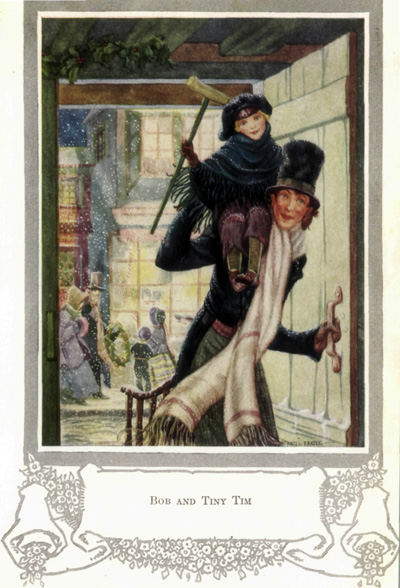
Tiny Tim on Bob's shouldersSo, what’s ahead for 2008? I can’t predict trends, but I can say what I hope for, and that’s a renaissance of words in their essential loneliness. Intellectual blogging is a medium that thrives because it captures the quietude of those moments when we seal ourselves off from our surroundings in order to consider the printed words of another person. The tremulousness of the word, the expectation of an answer, the abjection and shamelessness of writing for self-publication: in order to be honest, a blogger has to be vulnerable, more so even than the author of a book. What she is writing apparently had to be blogged to be written at all. Given the voluntarism of the blogosphere, polish is merely comic; risk is the only thing worth admiring. The risk of saying too much, the risk of being unread, the risk of being misread—intellectual blogging must change from an indifferent exercise of dignified exposition into the willing practice of risk.

The Ambivalence of Organisation

I just noticed the following in an article by Kenneth Davidson in The Age Business Day:

It is an inconvenient truth that unionised work forces can contribute to labour productivity by driving up wages faster than non-unionised work forces and this provides a stimulus to innovation, as employers will be motivated to economise on the use of labour by capital substitution.

Although this wasn’t my focus when I wrote recently on Marx’s chapter on the Working Day, this is one of the themes that plays out in that and subsequent chapters: the organisation of the working classes and the regulation of capital by the state and the public sphere are positioned in Marx’s narrative as factors that open the door for properly modern, mechanised industry – for the ongoing increases of productivity that characterise capitalism.

Davidson’s article doesn’t go on to address the paradox that working class organisation can thus lead to a displacement of the need for human labour – or the question so central to Marx, of how the need for human labour nevertheless continues to be reasserted in new forms, no matter how high productivity rises.

For readers from outside Australia who might click through to the article: no, Davidson isn’t just engaging in rhetorical flourish when he mentions the need to reinstate unfair dismissal laws.

Random Hegel

The other day, I was looking through Andy Blunden’s “The Meaning of Hegel’s Logic”, which I gather Andy prepared for the first Hegel Summer School back in 1997. I laughed at this comment, which Andy makes in his introduction:

Following Lenin’s advice, we recommend a “materialist reading” of the Logic. That is, where Hegel talks of a “spirit” which expresses or “posits” itself in Nature or human affairs, we read a law or process manifested or expressed by Nature or human activity; when Hegel starts talking about God, we skip to the next paragraph.

I meant to toss the comment up on the blog at the time, but got distracted and forgot. What reminded me was the following comment, from Hegel’s discussion in the Science of Logic of “With What Must Science Begin”:

If, therefore, in the expression of the absolute, or eternal, or God (and God has the absolutely undisputed right that the beginning be made with him) — if in the intuition or thought of these there is implied more than pure being — then this more must make its appearance in our knowing only as something thought, not as something imagined or figurately conceived; let what is present in intuition or figurate conception be as rich as it may, the determination which first emerges in knowing is simple, for only in what is simple is there nothing more than the pure beginning; only the immediate is simple, for only in the immediate has no advance yet been made from a one to an other. Consequently, whatever is intended to be expressed or implied beyond being, in the richer forms of representing the absolute or God, this is in the beginning only an empty word and only being; this simple determination which has no other meaning of any kind, this emptiness, is therefore simply as such the beginning of philosophy. (121)

Something about Hegel’s “and God has the absolutely undisputed right that the beginning be made with him” just kills me (you’ll have to forgive me – I frequently – and sympathetically, as a matter of sheer enjoyment in what he’s doing in the text – think Hegel is hilarious – I realise this reaction is highly idiosyncratic, but I still can’t seem to keep myself from sharing…). And the whole passage reminded me of Andy’s advice.

For those who haven’t seen it yet, the Hegel-by-Hypertext site, part of the ever-useful marxists.org, has online versions of a number of Hegel’s texts, and links to commentaries and other resources. As long as I’m assembling links, other useful sites for links to Hegel’s works and commentaries are J. Carl Mickelsen’s University of Idaho site (hat tip Self and World), and gwfhegel.org.

Design a site like this with WordPress.com
Get started